What Is the LANTITE? Format, Length, Difficulty and Who Has to Pass It
The LANTITE, the Literacy and Numeracy Test for Initial Teacher Education, is the test every student in an accredited Australian teaching degree must pass before they can graduate. It is two computer-based tests, literacy and numeracy, each 65 questions in 120 minutes, and ACER runs it on the Australian Government's behalf. It measures your own reading, writing and maths against one fixed standard: the top 30% of Australian adults. Not your teaching.
Who has to sit the LANTITE?
Every student in an accredited initial teacher education course, undergraduate or postgraduate. The rule sits in the national accreditation standards for teaching degrees: your university must confirm that pre-service teachers "are not eligible to graduate from the program without passing the LANTITE or showing First Nations language proficiency". Recognised First Nations language proficiency is the accepted alternative to the test.
You're expected to attempt it before the end of your first year. You don't have to pass by then, only sit it. Since April 2023 you can also sit it before you enrol, including in Year 11 or 12; that's optional.
Beyond graduation, the stakes depend on where you study:
- NSW: you must meet the standard before your final professional experience placement. From 1 August 2026 you also need it before NESA can grant Conditional accreditation, which lets you teach while you finish your degree.
- Victoria: you need it before the VIT grants provisional registration.
- Queensland and WA: it's a graduation requirement, not a registration one.
- Universities such as UNSW and Canberra hold back the final placement, or its grade, until you've passed.
One thing it isn't: a teaching exam. "LANTITE does not assess your ability to teach," says NESA. "It assesses the literacy and numeracy skills expected of future teachers."
The LANTITE format: two tests, 65 questions each
| Literacy | Numeracy | |
|---|---|---|
| Questions | 65 | 65: 52 with ACER's on-screen calculator, then 13 without |
| Sections | 1 | 2; section 1 closes once you start section 2 |
| Time | 120 minutes | 120 minutes in total |
| Counted | 60 (40 reading, 20 technical skills of writing) + 5 unscored trial questions | 60 (48 calculator, 12 non-calculator) + 5 unscored trial questions |
| Answers | multiple choice, statement grids, one typed word | multiple choice, statement grids, a number typed into a box |
| Sub-domains on your results | Reading · Technical Skills of Writing | Number and Algebra · Measurement and Geometry · Statistics and Probability · Calculator Available · Calculator not Available |
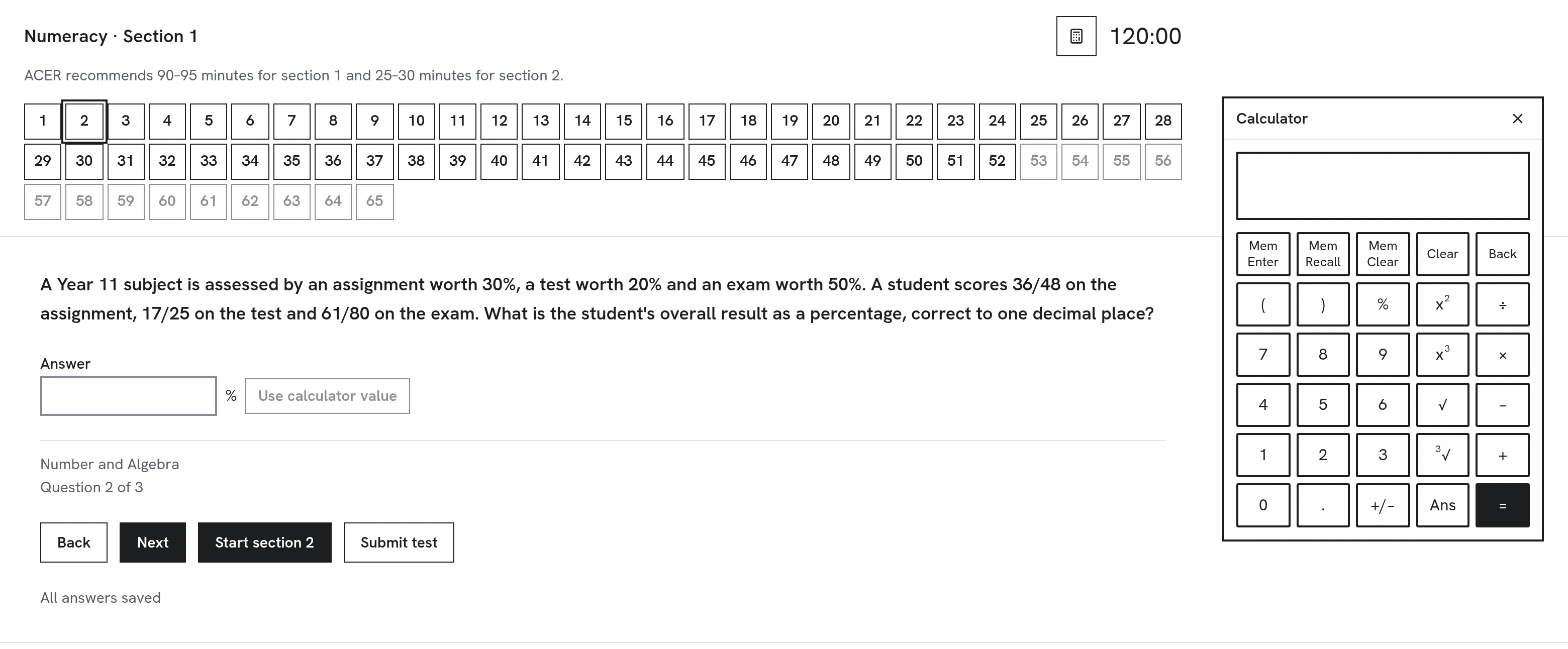
You register for, sit and pass the two components separately. Literacy runs as one section: about two-thirds of its questions are on reading texts and one-third test the technical skills of writing, meaning spelling, grammar and punctuation, word usage and text organisation LANTITE literacy. Numeracy is split. ACER suggests about 90–95 minutes for section 1 and 25–30 for section 2, but it's one clock, and once section 2 starts there's no way back LANTITE numeracy.
ACER's assessment framework (2024) gives the 60 + 5 split, but not which questions are the trial ones, so treat every question as counting. There's no essay. Every answer is a click, a row of Yes/No-style choices, one typed word or a number, and "marks are not deducted for incorrect responses". A blank is the only answer certain to score zero.
On screen, numbered boxes across the top turn black as you answer, and you can click back to any question in the section. ACER describes no flag-for-review button and advises noting question numbers on your scratch paper instead ACER's overview of the test. You sit at a test centre (in 2026, every capital city in every window, plus regional centres in some) or at home with a remote proctor, ProctorU; one mode per window covers all your components.
How long is the LANTITE test?
Each component gets 120 minutes on the on-screen clock, and a short tutorial comes first. That works out at under two minutes a question.
Your session runs longer. ACER tells test-centre candidates to allow at least 2½ hours per component, and remote sessions take at least 2 hours 30 minutes including 30 to 60 minutes of check-in. Sitting both? Allow five hours or more. You can split them across windows, since each component is registered separately.
Then there's the calendar. There are four test windows a year, and registration closes three weeks before each one; ACER says "late registrations will not be accepted under any circumstances". Results come about four weeks after the window closes. For 2027's first window, that means registering between 12 and 25 January, sitting between 15 and 28 February, and getting your result roughly four weeks after the window closes. Two to three months, end to end.
Is the LANTITE hard to pass?
Most people meet the standard first time. In 2025, 87.5% of first-time candidates met the literacy standard and 94.3% the numeracy standard (Department of Education). The flip side is the useful part: about 1 in 8 first-time candidates missed the literacy standard in 2025. Literacy, not maths, is the one that catches people.
The content isn't advanced. ACER describes the numeracy as "non-technical": percentages, GST, ratios, timetables, area and volume, graphs and box plots, with no Pythagoras and no finding equations. Most questions in both tests target levels 3 and 4 of the Australian Core Skills Framework. The difficulty is elsewhere:
- the standard itself, set at the top 30% of Australian adults;
- two hours of sustained reading in the literacy test, including texts ACER deliberately chooses because they're unlikely to be familiar;
- mechanics you won't meet anywhere else: a calculator with its own % rule, a section that locks behind you, corrections typed as one word.
Candidates who've written about sitting it often describe nerves and the clock, not hard content. That part responds to rehearsal. We built PassToTeach's two tests on ACER's published format: 65 questions in 120 minutes each, a numeracy calculator that behaves like ACER's, including the % key, and a section 2 that locks section 1 the moment you start it. A LANTITE practice test in that format lets you meet the timer, the calculator and the lock before the day, and how to pass the LANTITE sets out a study plan around it.
One full test, literacy or numeracy, your choice, after a free sign-up.
How LANTITE results work
To pass, you need to meet the standard in each component you sit. Results go to your ACER account on fixed dates, about four weeks after the window closes, and they "cannot be released early under any circumstances". Your statement says whether you achieved the standard, with your result shown in Band 1 (below the standard), Band 2 (at and above) or Band 3 (clearly above), and the same for each sub-domain. It shows no score. Nor is there a published pass mark: ACER says it can't give the number of questions or a percentage needed, because the number varies why there's no published pass mark.
A pass is permanent: you never sit that component again. Miss the standard and you re-sit the whole component, because sub-domain results don't carry over. Attempts have been unlimited since 2025, but every attempt costs A$98 per test (A$196 for both) in 2026, plus a window of your time. There are no appeals, no re-marking and no special consideration for illness on the day, and your university and teacher regulators can see your results.
Common questions
What does LANTITE stand for?
Literacy and Numeracy Test for Initial Teacher Education. Some ACER documents add "Students" at the end; it's the same test. Initial teacher education is the umbrella term for accredited teaching degrees, undergraduate or postgraduate.
What is the LANTITE test for?
It's how a teaching graduate shows that their personal literacy and numeracy sit in the top 30% of Australian adults, a standard validated in 2017 against the OECD's international survey of adult skills (PIAAC). The national accreditation standards make it a condition of graduating, and NSW and Victoria also tie accreditation or registration to it.
Can I sit the LANTITE before I start my degree?
Yes. Since April 2023, people planning to enrol in an accredited teaching course can sit it, Year 11 and 12 students included. It's optional. Once you're enrolled, you're expected to attempt it before the end of your first year.
How many attempts at the LANTITE do you get?
As many as you need. ACER: "Education Ministers agreed from 2025 there will be no test limits." You can sit each component once per window, and each attempt costs the fee again.
More on the LANTITE
· Test dates, registration and fees · When results come out · Free practice material, ACER's and ours · Frequently asked questionsOne payment, no expiry. 7-day money-back guarantee.
Written by the PassToTeach team. Test facts checked against ACER's candidate pages and assessment framework, the Department of Education's LANTITE data, AITSL's accreditation guidelines and NESA's and VIT's LANTITE pages on 25 October 2026.