LANTITE Literacy Practice Test: Reading and the Technical Skills of Writing
The LANTITE literacy test is 65 questions in 120 minutes, all in one section. About two-thirds are reading questions on shared texts; the other third test the technical skills of writing: spelling, grammar and punctuation, word usage and text organisation. There's no essay. Every answer is a click or one typed word. It's also the component more first-timers miss: in 2025, 87.5% of first-time candidates met the literacy standard and 94.3% the numeracy standard (Department of Education).
How the literacy test is built
One section, one clock, and questions that come in sets sharing a text or a theme; the set's name sits under the row of numbered boxes, with your place in the set ("question 2 of 6"). According to ACER's assessment framework (2024), 60 of the 65 questions count, 40 reading and 20 technical skills of writing, and 5 are unscored trial questions that ACER doesn't identify.
| Reading | Technical skills of writing | |
|---|---|---|
| Counted questions | 40 | 20 |
| What you work from | texts of about 100 to 900 words: continuous prose, non-continuous texts such as tables, and mixed texts | short documents with errors, sentences to reorder, words to replace |
| Answer formats | multiple choice, Yes/No statement grids | multiple choice, statement grids, one typed word |
| Sub-domain on your results | Reading | Technical Skills of Writing |
Statement grids are what ACER calls complex multiple choice: a list of statements with a choice to make on each row. Longer texts carry more questions; ACER says there may be eight or more on one text. The settings are everyday: about half personal and community, 30–40% schools and teaching, and 10–20% further education and professional learning ACER's test content page. For the rules both components share, from registration to results, see our guide to what the LANTITE is.
Spelling · Grammar and punctuation · Word usage · Text organisation: 20–30% each
Reading: how the questions work
ACER strongly recommends reading each text in full before its questions, and it's right. Long texts scroll ("Scroll to read more"), and some questions hyperlink a word to the part of the text it refers to, which then appears highlighted.
Reading questions test three things. Access and identify, 35–45% of the reading questions: find what the text states. Integrate and interpret, 40–50%: connect parts of the text and work out what the writer means or thinks. Evaluate and reflect, 10–20%: judge purpose, evidence and the effect of the language. ACER's own band descriptions follow the same ladder, from locating stated information, to inferring the writer's position, to interpreting the effect of language.
Expect texts on subjects you know nothing about. ACER deliberately includes material "unlikely to be familiar to the candidates", which tells you how to answer: from the text, never from what you happen to know.
Grids are where careful readers drop marks. Here's one we wrote:
Music practice rooms from Term 3 (a notice we wrote for this page) From the start of Term 3, students can book the music practice rooms before school from 7.45 am, a quarter of an hour earlier than now. Students in Years 7 to 9 may book one session a week; senior students may book three.
Does the notice give evidence for each claim? Choose Yes or No for every row.
- Senior students can book more sessions a week than Year 8 students. Yes: three against one.
- The rooms can be booked on weekends. No: the notice only mentions before school.
- Bookings currently start at 8 am. Yes: 7.45 am is "a quarter of an hour earlier than now".
- Most senior students book three sessions a week. No: three is a limit, not what students do.
Rows 2 and 4 sound reasonable, and the notice says neither. "Not stated" is a No. You must answer every row before the question counts as answered, and in ACER's practice keys a grid is marked as one question.
Technical skills of writing: the four areas
ACER spreads these questions across four areas, each 20–30% of them:
- Syntax and grammar, including punctuation: commas, apostrophes, punctuating speech, agreement and tense. "There is two spare seats in the front row" needs "are".
- Spelling: frequently misspelt words that an adult in the top 30% for literacy would be expected to know.
- Word usage: the word closest in meaning in context, and the right register. In a formal report, "the kids" becomes "the students".
- Text organisation: putting sentences or paragraphs in order, placing a phrase or idea where it belongs, and spotting ambiguity caused by poor links between sentences.
Often you work from a short document with errors to fix, sentences to reorder or an informal word to make more formal. Answers are multiple choice or a single typed word.
Typed answers: one word, or N
When a sentence may contain a spelling or grammar error, you type the correct word, one word only, or type N if there's no error. Three of ours:
- "The new timetable will definately start on Monday." Type definitely.
- "The visiting authors signed there books for the students." Type their.
- "The excursion has been postponed until the weather improves." Type N.
The format itself can cost marks: typing two words or the whole phrase, "correcting" a word that was fine, or forgetting that N is a real answer. Our literacy forms use Australian spelling and never test a word with two accepted spellings, so judgement against judgment never decides a mark.
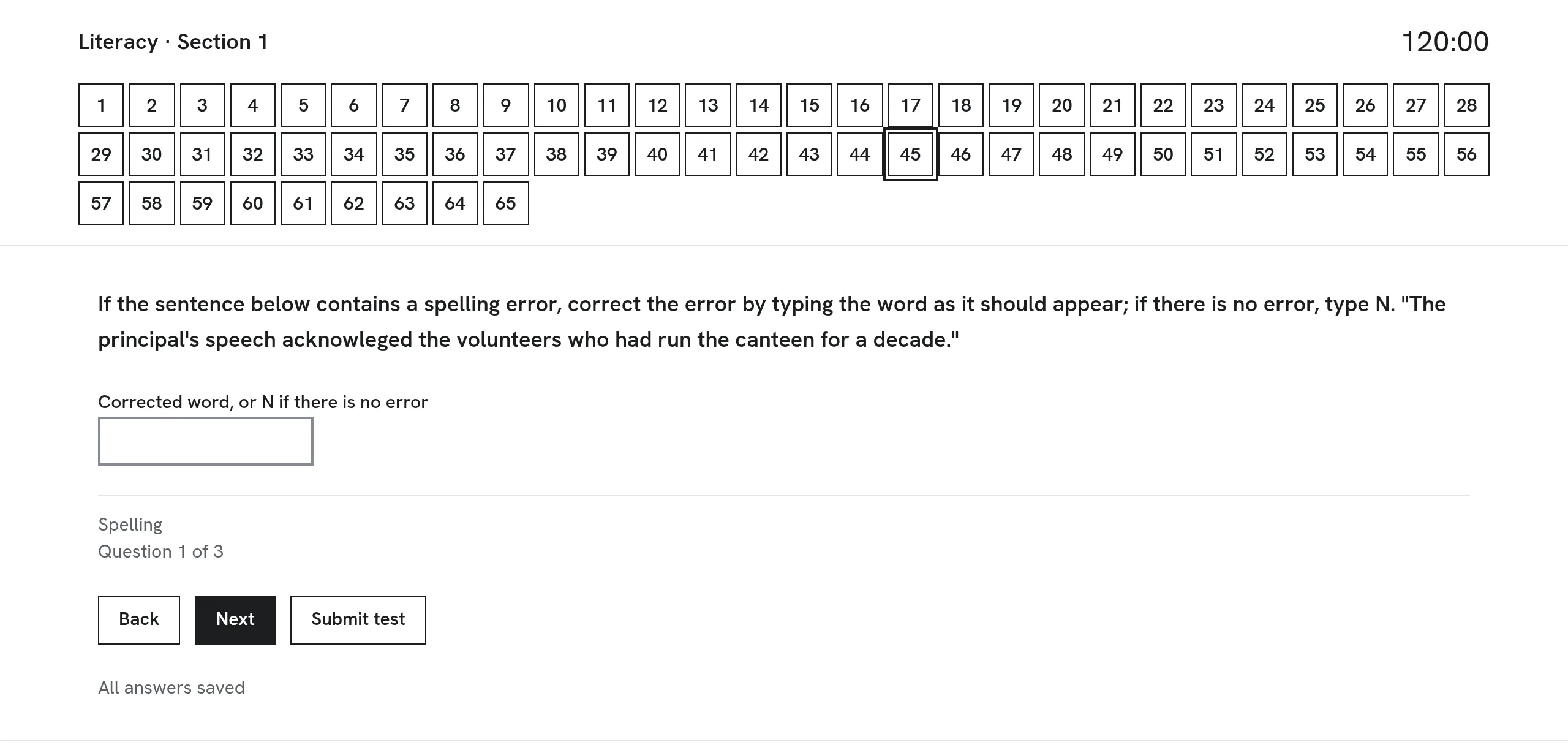
Your one free full test can be this one: 65 questions with reading sets and typed corrections, after a free sign-up.
How to practise for LANTITE literacy
- Build reading stamina. 120 minutes of close reading is a long stretch; practise on long texts on a screen, against the clock.
- Prove every answer. Before you click, find the sentence that makes your answer true. If you can't point to it, it's probably a distractor.
- Keep a personal spelling list. Words you've misspelt in practice are the ones to test yourself on each week.
- Drill the usual grammar suspects: its and it's, plural possessives (children's, teachers'), agreement after words like "each" and "neither", and commas around information the sentence could do without.
Each of our literacy forms has 44 reading and 21 writing questions, the split in ACER's own full practice test. Every form mixes long and short texts, including one of more than 800 words, at least one table or form, a narrative and an opinion piece, and an independent checker re-solved every question blind, without the answer key, before the forms were finalised. Our literacy "Above the standard" cut-offs sit slightly higher than the raw-score ranges ACER publishes for its own practice tests, until real results let us calibrate them; here's how we set our bands. A full LANTITE practice test tells you which of the two literacy sub-domains needs the work, and a week-by-week study plan turns that into a schedule. Sitting both components? The calculator rules are in our guide to the numeracy test.
Common questions
How many questions are in the LANTITE literacy test?
65, in one 120-minute section. 60 count (40 reading, 20 technical skills of writing) and 5 are unscored trial questions (ACER's assessment framework, 2024).
Is there an essay in the LANTITE literacy test?
No. ACER says "no extended writing is required". The writing sub-domain tests technical skills through multiple choice and one-word answers.
How can I prepare for the LANTITE literacy exam?
Take one full timed test first, then work on whichever sub-domain came out weaker. Read every text before its questions, and practise the one-word typed format until it's automatic.
One payment, no expiry. 7-day money-back guarantee.
Written by the PassToTeach team. Test facts checked against ACER's test content page, assessment framework and practice-test instructions on 25 October 2026.