LANTITE Numeracy Practice Test: Sections, Calculator Rules and Topics
The LANTITE numeracy test is 65 questions in 120 minutes, in two sections: 52 questions with ACER's on-screen calculator, then 13 with no calculator at all. Start section 2 and section 1 closes for good, so pacing matters as much as the maths.
Two sections, one clock: how the numeracy test is laid out
| Section 1 | Section 2 | |
|---|---|---|
| Questions | 52 | 13 |
| Calculator | ACER's on-screen calculator | none: blank scratch paper only |
| ACER's suggested time | about 90–95 minutes | about 25–30 minutes |
| Going back | closes for good once section 2 starts | free within the section |
Of the 65 questions, 60 count (48 with the calculator, 12 without) and 5 are unscored trial questions, according to ACER's assessment framework (2024). ACER doesn't say which ones, so answer every question as if it counts. Three answer formats appear: a number typed into a box, statement grids where you choose True/False or Yes/No for each row, and multiple choice with usually four options. In ACER's own full practice test, 32 of the 65 answers are typed numbers, 21 are grids and 12 are multiple choice (our count of ACER's published answer key), and ACER says that practice test reflects the live test's item types. Marks are not deducted for wrong answers, so never leave a blank.
ACER's warning about the lock is blunt: "It is important not to rush section 1 because you will not be able to return to section 1 once you commence section 2" ACER's test overview. Both sections share one 120-minute clock. The 90–95 and 25–30 minute figures are ACER's recommendations, not separate allotments, so time you save in section 1 carries into section 2 and time you overspend comes out of it.
That sets the pace. About 92 minutes for 52 questions is roughly 1¾ minutes each; section 2 gives you about 2 minutes a question. Before you leave section 1, scan the numbered boxes across the top: an answered question's box turns black, an unanswered one stays unshaded. Once section 2 starts, section 1 is gone. Our numeracy test asks you to confirm, then locks section 1 the same way, so the first time you meet that moment isn't on test day.
The on-screen calculator, and the % key that catches people
Personal calculators are banned. In section 1 you get ACER's on-screen calculator: you open it from an icon at the top right, drag it where you like, and enter numbers with the mouse or the keyboard. It has memory keys, brackets, squares and cubes, square and cube roots, +/− and an Ans key that holds the last result. Three behaviours matter more than the keys. All three are in ACER's 2019 guide to the on-screen calculator; where an example is ACER's own, we say so:
- It follows the order of operations. 3.25 + 4.75 × 2 gives 12.75, because the multiplication happens first. With brackets around the addition, (3.25 + 4.75) × 2 gives 16.
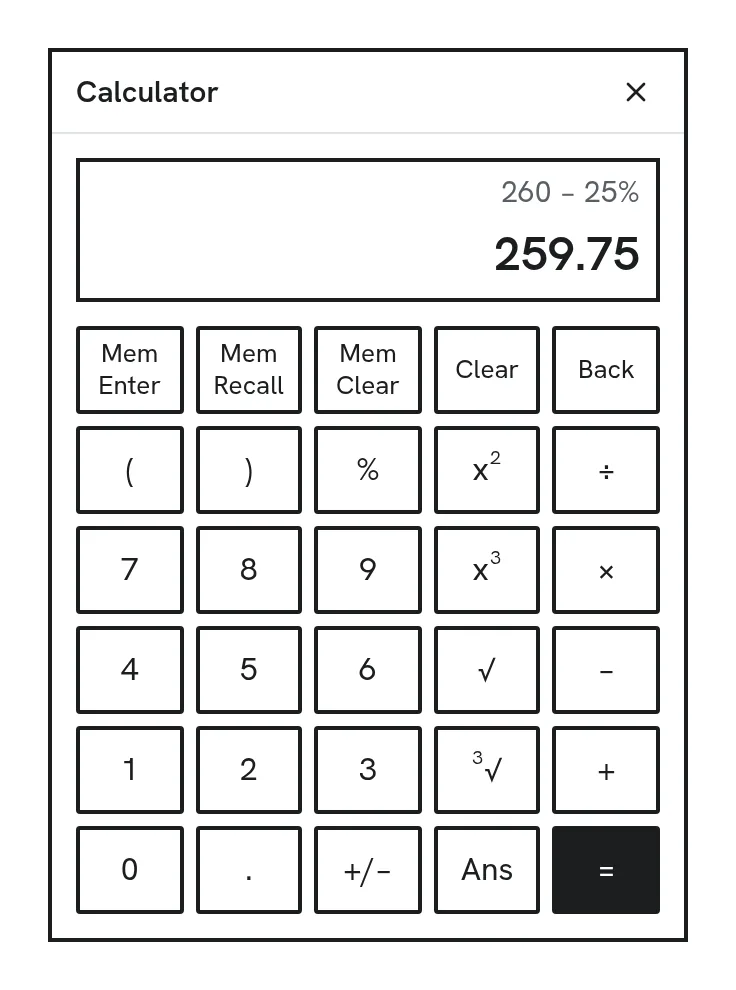
- The % key turns a percentage into a decimal. ACER's example: "$1250 – 15%" gives 1249.85, "because the calculator converts 15% to 0.15 and then subtracts 0.15 from 1250". Multiplying behaves as you'd expect: 25% × 260 gives 65.
- It closes when you move to the next question. Use the "Use calculator value" button beside the answer box to paste your result before you go.
Here's the trap in numbers of our own. A $260 jacket is 25% off. Type 260 − 25% and you get 259.75, a 25-cent discount. Type 260 × 0.75, or 260 − 260 × 25%, and you get the $195 you wanted. GST works the same way: a $66 price that includes GST is not "66 − 10%". The price before GST is 66 ÷ 1.1 = $60, so the GST is $6.
When we built the calculator for our numeracy test, we tested it against ACER's documented examples, including its 1250 − 15% case, and it returns the same results. Registered candidates can also try ACER's calculator in the practice questions in their ACER account.
Your one free full test can be this one: 65 questions with the calculator and the section lock, after a free sign-up.
Section 2 without a calculator: what to drill
ACER describes section 2 questions as "typically familiar, routine and common applications and operations with appropriate numbers"; calculations with many steps, complex operations or uncommon decimals, fractions and percentages are kept out. So the section rewards fluency, not tricks. Our section 2 questions follow the same rule. Drill these until they're quick:
- Easy percentages. 35% of $60: 10% is $6, so 30% is $18; add 5%, which is $3, to get $21.
- Fractions of a quantity. Three-quarters of 64 is 48.
- Money. Four items at $2.95 each: 4 × $3 is $12, less 20 cents, so $11.80.
- Time. A 95-minute session that starts at 12.50 pm ends at 2.25 pm.
- Estimation. 396 × 0.26 is about 400 × 0.25, so about 100.
What the numeracy test covers
ACER's framework puts number and algebra at 40–50% of the test, statistics and probability at 25–35%, and measurement and geometry at 20–30%. The scope is what ACER calls "non-technical":
- Number and algebra: ratios and rates, fractions, decimals and percentages, weighted percentages across assignments, converting raw scores to grades, money, budgeting, interest, GST, and substituting into a formula you're given.
- Measurement and geometry: time and timetables, 2D and 3D shapes, area and volume, metric conversions, maps, scales and bearings.
- Statistics and probability: reading graphs and tables, comparing data sets, box plots and distributions, sampling and bias, NAPLAN-style results and ATAR ranks.
Pythagoras and finding equations are out of scope. Expect about half the questions in personal and community settings, 30–40% in schools and teaching, and 10–20% in further education and professional learning. Your ACER statement reports five numeracy sub-domains: Number and Algebra, Measurement and Geometry, Statistics and Probability, Calculator Available and Calculator not Available. Our full results use the same five, each with a band labelled as our estimate; here's how we turn a practice score into a band.
A one-page numeracy revision sheet
Learn these before the day; on test day you work on blank scratch paper.
- GST: price before GST = price including GST ÷ 1.1; the GST is the price including GST ÷ 11.
- Percentage change: (new − old) ÷ old × 100. From 400 to 460 is 60 ÷ 400 = 15%, not 60 ÷ 460.
- Weighted result: add each mark × its weight. 70% on an assignment worth 40% and 80% on an exam worth 60% gives 0.7 × 40 + 0.8 × 60 = 76%.
- Simple interest: principal × rate × years.
- Speed and time: speed = distance ÷ time; decimal hours × 60 = minutes, so 0.4 h is 24 minutes, not 40.
- Area and volume: rectangle l × w; triangle ½ × b × h; circle π × r²; prism = area of the end × length.
- Units: 1 m² = 10,000 cm²; 1 L = 1,000 mL; 1 cm³ = 1 mL; 1 m³ = 1,000 L.
- Statistics: mean = total ÷ count; median = the middle value in order; mode = the most common; range = highest − lowest; a box plot shows the minimum, lower quartile, median, upper quartile and maximum.
- Chance: probability = favourable outcomes ÷ equally likely outcomes.
Once these are automatic, a LANTITE practice test under full timing shows whether they hold up at minute 100, and a six-week study plan puts them in order. If numeracy is your strong component, look hard at the LANTITE literacy test: in 2025, 87.5% of first-time candidates met the literacy standard and 94.3% the numeracy standard (Department of Education).
Common questions
Can I use my own calculator in the LANTITE?
No. ACER says "personal calculators cannot be used for the test". Section 1 gives you ACER's on-screen calculator; section 2 gives you none.
How many questions are in the LANTITE numeracy test?
65, in 120 minutes: 52 with the on-screen calculator, then 13 without. Of those, 60 count towards your result and 5 are unscored trial questions (ACER's assessment framework, 2024).
Where can I find practice questions for the LANTITE numeracy test?
Start with ACER: a free full practice test with worked solutions, plus sample, practice and retired question sets, and, once you've registered, online practice tests and practice questions with the on-screen calculator in your ACER account. We've gathered them, with our own free full test, on one page: free LANTITE practice material.
One payment, no expiry. 7-day money-back guarantee.
Written by the PassToTeach team. Test facts checked against ACER's test overview, assessment framework and guide to the on-screen calculator on 25 October 2026.