How to Pass the LANTITE: Start With a Timed Baseline, Then Fix the Weakest Topics
Sit one full test against the 120-minute clock before you study anything, then spend your hours on the sub-domains that cost you marks. That's the method. In 2025, 87.5% of first-time candidates met the literacy standard and 94.3% the numeracy standard (Department of Education), so passing the LANTITE isn't about cramming a syllabus. It's about finding your one or two weak spots early enough to fix them before your window.
Step 1: take a timed baseline, not a quiz
A question set tells you what you know. A full timed run tells you what you can still do at minute 100, which is the version of you that sits the test. Each component is 65 questions in 120 minutes, under two minutes a question, and pacing problems only show up across the whole run.
There are two clean ways to get that baseline. ACER publishes a full 65-question practice test for each component as a free PDF, with score tables and worked solutions, and registered candidates also get online practice tests that report against the standard ACER's practice material. ACER says its score ranges are reliable "only for candidates on their first attempt and before they view the worked solutions". So treat that test as a one-time benchmark: if you're registered, sit the online version before you open the PDF or its solutions, and sit it timed. The other way: our first full timed test is free, either component, and gives you a score and an overall band LANTITE practice test.
Write down three things from the baseline: your result in each sub-domain, how long each section took, and how many questions you left blank or guessed. ACER's score tables give a range for each sub-domain. Literacy has two, Reading and Technical Skills of Writing; numeracy has five: Number and Algebra, Measurement and Geometry, Statistics and Probability, and the calculator and no-calculator sections. Our full results use the same seven, so each run breaks down under the same headings as the statement you'll get in your ACER account.
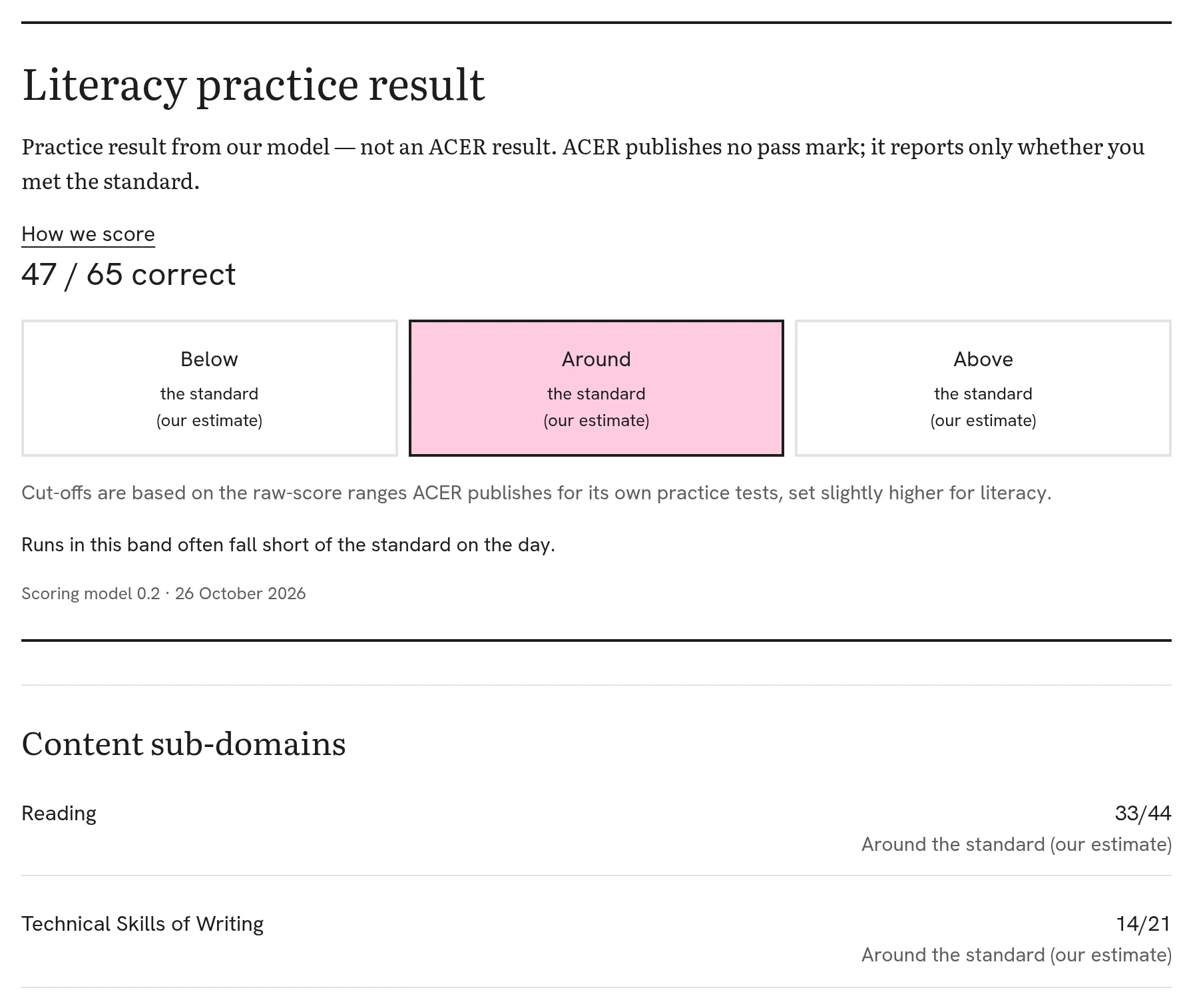
One full timed test, literacy or numeracy, your choice.
Step 2: plan backwards from your window
Registration is the first deadline. It closes at 5 pm Melbourne time three weeks before each window, and "late registrations will not be accepted under any circumstances". The first window of 2027 takes registrations from 12 to 25 January and runs from 15 to 28 February 2027; the others run 10–23 May, 9–22 August and 1–14 November 2027. If you need adjustments such as extra time or a reader, the application is due by the same registration close, every window.
Here's the plan we'd use with six weeks to go:
| When | What |
|---|---|
| Week 6 | Baseline: one full timed test of each component you're sitting |
| Weeks 5–4 | Your weakest sub-domain, untimed: every wrong answer reviewed until you can say why the right one is right |
| Week 3 | A second full timed test; compare sub-domains and section times |
| Week 2 | The next-weakest area, plus mechanics: the calculator, typed corrections, statement grids |
| Week 1 | A last full timed test early in the week, then light review and sleep |
Less time? Keep the shape: baseline, targeted work, one more full run. Waiting on a Window 4 2026 result, due in the week ending 4 December? The next window after it is 15–28 February 2027, so you can start on your weakest sub-domain before registration opens on 12 January.
Each attempt costs A$98 per test (A$196 for both) in 2026, and the fee can't go on HECS-HELP. That's the case for walking in prepared rather than paying again to find out.
Step 3: fix the weakest sub-domain first
You don't need every sub-domain at the standard. ACER says a component "may be achieved without reaching the standard in every sub-domain", and the overall result "is not a simple average" of them. So lift the area that's furthest below, rather than polishing the one you're already good at.
Know where the marks sit. In ACER's assessment framework (2024), 40 of the 60 counted literacy questions are reading; the other 20 are technical skills of writing, spread across spelling, grammar and punctuation, word usage and text organisation. For numeracy, the same framework puts number and algebra at 40–50% of the test, statistics and probability at 25–35% and measurement and geometry at 20–30%, and 13 questions come with no calculator at all.
- Literacy: read full texts against the clock; ACER's texts run from about 100 to about 900 words, and eight or more questions can hang off one text. For the writing questions, drill frequently misspelt words, apostrophes, subject–verb agreement and choosing the more formal word. More on the literacy test, question type by question type.
- Numeracy: percentages and GST, rates and ratios, unit conversions, and reading tables, graphs and box plots, plus quick written arithmetic for section 2. More on LANTITE numeracy practice.
Our Starter drills work one sub-domain at a time, untimed, with feedback on every answer, which is the weeks 5–4 job in the plan above.
Step 4: rehearse the mechanics until they're boring
Mechanics you've never touched turn into test-day stress. These are ACER's rules and advice, from its test-taking strategy page and test guides, and our tests use the same rules, so none of this is new on the day:
- Answer everything. Marks aren't deducted for wrong answers, so a guess beats a blank.
- Read the whole text first. ACER strongly recommends reading a text in full before its questions.
- No flag button. Write the numbers of questions you want to revisit on your scratch paper; the boxes across the top let you jump back within a section.
- Don't rush numeracy section 1. Once you start section 2, section 1 is closed for good. ACER suggests about 90–95 minutes for section 1 and 25–30 for section 2.
- Watch the % key. ACER's calculator turns 15% into 0.15, so "1250 − 15%" gives 1249.85, not 1062.50 (ACER's own example). Multiply instead: 1250 × 0.85.
- Paste, then move. The calculator closes when you go to the next question; use the "Use calculator value" button before you leave.
- Numbers only. Units are printed beside the answer box; type a unit or a word and it isn't saved.
- Every row of a grid. Leave one row blank and the question stays marked as unanswered.
- One word, or N. A typed correction is a single word; if the sentence has no error, type N.
Tutor, course or self-study?
Check what your university offers first; several publish free LANTITE guides for their students. A tutor earns the fee when your baseline shows a gap you can't explain yourself and you want someone to watch you work. In our view, most candidates need pacing and a handful of rusty skills more than a course, and timed practice with careful review covers both.
Whatever you choose, check it against ACER's own pages. ACER "does not recommend or endorse any commercially available courses", PassToTeach included, and warns that "some commercial preparation courses might provide misleading information". Some prep pages still print the old attempt limit; it was removed from 2025. Start with every free LANTITE practice resource, ACER's included, before you pay anyone.
Common questions
How long should I study for the LANTITE?
It depends on your baseline, which is why you take it first. If your first timed run clears every sub-domain comfortably, a couple of weeks on mechanics may be enough. If one area sits well below, give that area several weeks before your next full run.
Can I take ACER's practice test more than once?
The online versions, yes: ACER issues a new report each time. But ACER says its score ranges hold only on a first attempt, before you've seen the worked solutions, so your second report says less than your first.
What happens if I don't meet the standard?
Your statement shows how you went in each sub-domain, with notes on what to work on next. You re-sit the whole component in a later window, paying the fee again; attempts are unlimited since 2025. Start this plan again from Step 3, with the statement as your baseline.
How do I know when I'm ready?
When your full timed runs land in our "Above the standard" band in the sub-domains that were weak, with time to spare in each section. That band is always labelled as our estimate, never ACER's verdict, and the method behind it is public: how our score estimate works.
Starter for untimed drills by sub-domain; Elite for every full form of both tests, with worked solutions. One payment, no expiry. 7-day money-back guarantee.
Written by the PassToTeach team. Test facts checked against ACER's candidate pages and practice-test guides and the Department of Education's LANTITE data on 25 October 2026.